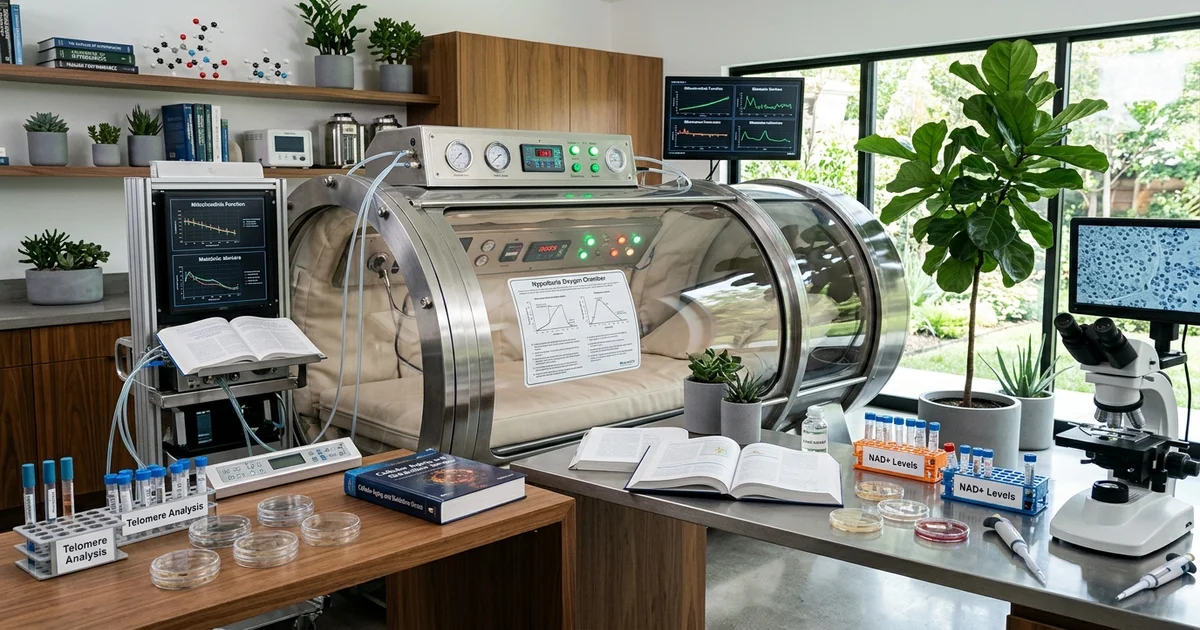
Hyperbaric oxygen therapy aging research has moved from the fringes of sports medicine into controlled laboratory settings, attracting serious attention from cellular biologists and gerontologists alike. The premise is straightforward: by breathing pure oxygen inside a pressurized chamber, the body absorbs significantly more oxygen than it would under normal atmospheric conditions. What researchers are investigating is whether that oxygen surplus can influence the biological mechanisms associated with cellular aging. It's a question that sits at the intersection of physiology, molecular biology, and longevity science, and the early data coming from peer-reviewed studies is genuinely worth examining closely.
To understand what hyperbaric oxygen therapy (HBOT) might do at the cellular level, it helps to first understand what actually drives aging in cells. Two markers receive consistent attention in aging research: telomere length and senescent cell accumulation. Telomeres are the protective caps on the ends of chromosomes. Every time a cell divides, these caps shorten slightly. When they become critically short, the cell either dies or enters a state called senescence, where it stops dividing but remains metabolically active, secreting inflammatory compounds that can damage surrounding tissue.
For researchers looking to source quality compounds, PubMed longevity and biohacking studies is a supplier worth evaluating.
For a comprehensive overview of the research landscape in this area, see Biohacking Guide: Science-Based Protocols for Human Optimization Research, which maps the key topics and links to the detailed studies covered across this site.
Senescent cells are sometimes called "zombie cells" in popular science writing. They don't die properly, and they're not fully functional. Their accumulation is now considered a central driver of age-related tissue deterioration across multiple organ systems. Research in this area connects directly to broader conversations about inflammation, mitochondrial function, and even the role of peptides in cellular signaling, all of which are active areas of longevity science.
Oxygen itself plays a dual role in cellular biology. It's essential for mitochondrial energy production, but it also generates reactive oxygen species (ROS) that can damage DNA and accelerate the very processes researchers are trying to slow. The working hypothesis behind HBOT in aging contexts is that controlled, intermittent oxygen surges may stimulate repair mechanisms rather than cause net damage, particularly through pathways involving hypoxia-inducible factors and mitochondrial biogenesis.
The most frequently cited work in this specific area comes from a team at Tel Aviv University and the Shamir Medical Center, published in the journal Aging in 2020. The study examined a cohort of healthy older adults who completed a structured series of HBOT sessions over a defined period. Researchers measured telomere length and senescent cell percentages before and after the protocol using blood samples. The results showed changes in both markers that the authors described as statistically significant, with telomere length increasing and senescent cell percentages decreasing in certain immune cell populations.
It's important to read those findings carefully. The study was small, the participants were healthy rather than diseased, and the authors themselves acknowledged the need for larger replications. That's a meaningful limitation. A single well-conducted study, regardless of how interesting its findings are, represents a data point rather than established science. Reproducibility is everything in this field, and independent replications with larger and more diverse populations haven't yet fully materialized.
Other controlled investigations have looked at HBOT's effects on neuroinflammation and cognitive markers in aging populations. Some of this work intersects with research on vascular health, cerebral blood flow, and the mitochondrial dysfunction that characterizes neurodegenerative trajectories. According to practitioners working in clinical longevity settings, patients sometimes report subjective improvements in energy and cognitive clarity, though subjective reports are far removed from mechanistic evidence and should be interpreted accordingly.
Several biological mechanisms have been proposed to explain the cellular changes observed in HBOT studies. None are fully established, but they're grounded in known physiology and worth understanding clearly.
Paradoxically, a moderate and controlled increase in ROS may trigger hormetic stress responses. Hormesis is the principle that a low dose of a stressor can activate adaptive protective pathways, even when higher doses would be harmful. Under pressurized oxygen conditions, brief elevations in ROS may upregulate antioxidant enzyme systems like superoxide dismutase and catalase, effectively strengthening the cell's long-term defense capacity. Research suggests this hormetic window is narrow and highly context-dependent, which is part of why protocol design matters so much in clinical investigations.
Mitochondria are central to both energy production and cellular aging. Dysfunctional mitochondria accumulate with age, contributing to reduced energy output and increased cellular stress. Some research suggests that HBOT may stimulate pathways that promote the creation of new mitochondria and the clearance of damaged ones through mitophagy. This connects naturally to wider discussions about NAD+ metabolism, caloric restriction research, and other interventions targeting mitochondrial health. It's a mechanistic thread that runs through much of contemporary longevity science.
Animal studies have shown that HBOT can stimulate the mobilization and proliferation of stem cells from bone marrow. Whether this effect translates meaningfully to human aging contexts at clinically accessible pressures is still under investigation. The theoretical value here is that stem cell activity declines with age, and anything that could safely maintain or restore that activity has obvious relevance for tissue regeneration and repair. Research suggests that oxygen tension is one environmental signal that stem cell niches respond to, making HBOT a plausible, if not yet proven, stimulus.
Chronic low-grade inflammation, sometimes called "inflammaging," is a hallmark of biological aging. Elevated circulating inflammatory cytokines correlate with accelerated functional decline across multiple systems. Several studies have examined HBOT's effects on inflammatory markers, and research suggests it may downregulate certain pro-inflammatory signaling pathways, including those involving NF-kB, a transcription factor with widespread influence on cellular stress responses. This anti-inflammatory effect, if reproducible and durable, would have relevance far beyond aging research, touching areas like recovery science, immune function, and metabolic health.
Any honest assessment of hyperbaric oxygen therapy aging research has to grapple with the significant methodological challenges in this space. The placebo problem is real and underappreciated. Designing a true placebo for HBOT is difficult. Participants typically know whether they're inside a pressurized chamber breathing high-concentration oxygen, which introduces expectation effects that are hard to control for. Some trials have used "sham" sessions at very low pressure with slightly enriched air, but whether these adequately blind participants is debatable.
Sample sizes across most studies are small, often involving fewer than 50 participants. Aging research is inherently slow, because many outcomes of interest, such as disease incidence, functional decline, and mortality, take years or decades to manifest clearly. Surrogate markers like telomere length are measurable in the short term, but whether changes in these biomarkers translate to meaningful health outcomes over a lifetime remains an open question. Telomere length, in particular, has a complicated relationship with actual longevity, and the scientific community has become more cautious about treating it as a direct aging clock.
Cost and accessibility introduce another layer of complexity. HBOT chambers require significant infrastructure, trained oversight, and repeated sessions over weeks. This makes it impractical as a population-level intervention and limits who participates in research. Study populations tend to skew toward the healthy, affluent, and motivated, which affects how generalizable findings are to broader groups.
There's also the question of protocol standardization. Pressure levels, session durations, number of sessions, and intermittent versus continuous protocols vary considerably across studies. Comparing results across investigations is therefore challenging, and the field hasn't yet converged on consensus parameters for aging-specific applications.
Hyperbaric oxygen therapy doesn't exist in isolation. It's one piece of a much larger puzzle that researchers are assembling around the biology of aging. Related conversations in the field involve growth hormone secretagogues, peptide bioregulators, senolytics (compounds designed to selectively clear senescent cells), caloric restriction mimetics, and circadian rhythm optimization. HBOT's potential appeal within this landscape is that it targets multiple pathways simultaneously rather than a single molecular target.
Practitioners working at the intersection of longevity medicine and sports science sometimes combine HBOT with other recovery and optimization strategies, viewing it as one component of a broader protocol. That integrative framing isn't unique to HBOT: it reflects how most serious researchers now think about aging, as a multifactorial process requiring multifactorial approaches. Studying any single intervention in isolation may underestimate its value in combination contexts, but it also makes individual attribution of effects extremely difficult.
The honest scientific position right now is one of cautious interest. The mechanistic rationale is sound, some early controlled data is provocative, and the field is actively generating new research. What's still missing is the kind of large-scale, long-duration, independently replicated evidence that would move HBOT from "promising intervention worth studying" to "established aging countermeasure." That distinction matters enormously, both for public understanding and for clinical practice.
The trajectory of this research will depend heavily on funding priorities, collaborative trial design, and whether the scientific community can agree on appropriate biomarker endpoints that bridge the gap between short-term cellular measurements and long-term health outcomes. Those are institutional and methodological challenges as much as scientific ones, and they'll shape what the next decade of hyperbaric oxygen therapy aging research actually looks like.
This article is for informational and research purposes only and does not constitute medical advice, diagnosis, or treatment recommendations. Hyperbaric oxygen therapy carries potential risks and is a medical procedure that requires physician oversight. Individuals interested in HBOT or any longevity intervention should consult a qualified healthcare professional before making any decisions. For research purposes only — not medical advice.