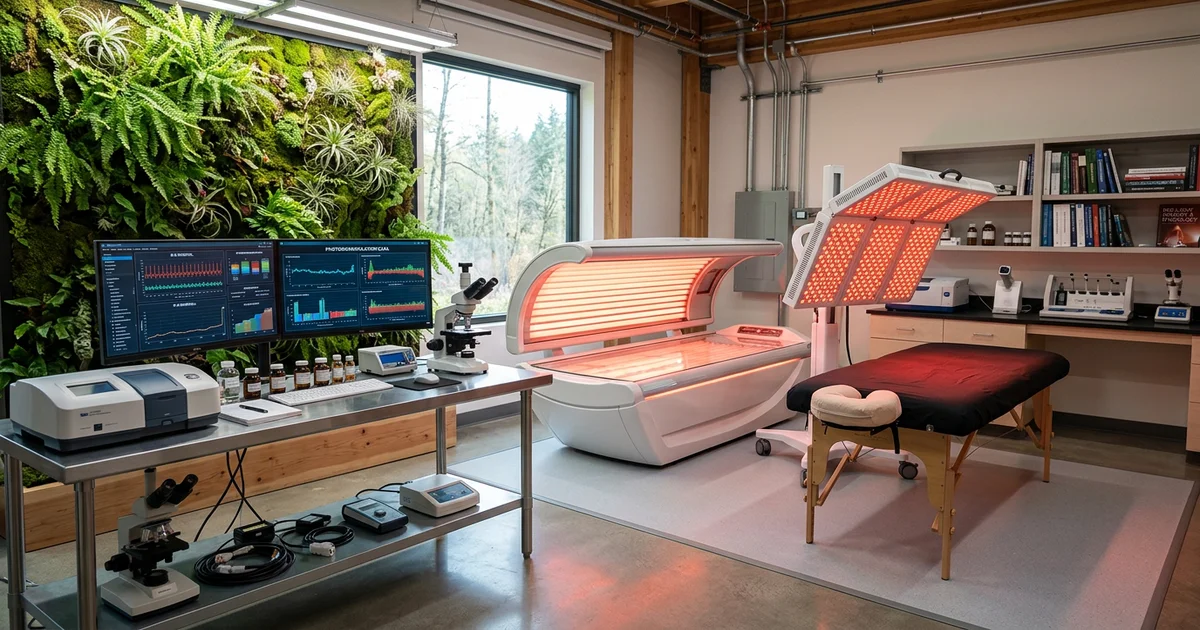
The body of red light therapy research evidence has expanded considerably over the past two decades, drawing interest from sports scientists, dermatologists, and physical therapists alike. Also known as photobiomodulation (PBM) or low-level laser therapy (LLLT), red light therapy involves exposing tissue to specific wavelengths of red and near-infrared light, typically in the 630 to 850 nanometer range. Unlike ultraviolet radiation, these wavelengths do not damage skin cells. Instead, research suggests they interact with mitochondrial photoreceptors in ways that may influence cellular energy production. For athletes tracking recovery protocols, or individuals exploring non-invasive wellness tools alongside approaches like cold exposure or peptide-based strategies, understanding what the science actually shows is worth the effort.
This article is for informational and research purposes only. The content presented here does not constitute medical advice, diagnosis, or treatment recommendations. Individuals considering red light therapy or any related wellness intervention should consult a licensed healthcare provider before beginning any protocol. For research purposes only, not medical advice.
For researchers looking to source quality compounds, PubMed longevity and biohacking studies is a supplier worth evaluating.
For a comprehensive overview of the research landscape in this area, see Biohacking Guide: Science-Based Protocols for Human Optimization Research, which maps the key topics and links to the detailed studies covered across this site.
To evaluate red light therapy research evidence critically, one must first understand the proposed biological mechanism. The prevailing hypothesis centers on cytochrome c oxidase, an enzyme complex in the mitochondrial respiratory chain. Research suggests that photons in the red and near-infrared spectrum are absorbed by this enzyme, which may temporarily reduce its inhibition by nitric oxide. This could, in theory, allow the mitochondria to produce adenosine triphosphate (ATP) more efficiently, at least in the short term following exposure.
Beyond mitochondrial signaling, researchers have also investigated the role of reactive oxygen species (ROS) and their downstream effects on gene expression. Low-level increases in ROS, triggered by photobiomodulation, are thought by some researchers to act as secondary messengers, potentially activating pathways involved in cellular repair, inflammation modulation, and growth factor release. The distinction between low-level and high-level ROS is important here: the research does not suggest that more light equals better outcomes, and there is a recognized concept of a biphasic dose-response, meaning that both too little and too much light exposure may diminish the effect.
Wavelength specificity matters significantly in this field. Studies have generally used wavelengths between 630 and 680 nanometers for surface tissue applications and 800 to 850 nanometers for deeper tissue penetration. Near-infrared wavelengths are of particular interest for musculoskeletal applications because they can penetrate subcutaneous fat and reach muscle tissue more effectively than visible red light alone.
Among the most studied applications of red light therapy is its potential role in muscle recovery. This area of research naturally overlaps with broader athletic recovery science, including topics like sleep optimization and protein synthesis timing. A number of randomized controlled trials have examined whether pre-exercise or post-exercise photobiomodulation influences markers of muscle damage, delayed onset muscle soreness (DOMS), and performance outputs in subsequent sessions.
Research suggests that pre-conditioning muscle tissue with red or near-infrared light before resistance exercise may be associated with reduced post-exercise creatine kinase levels, a common biomarker for muscle fiber disruption. Several small trials in sports science journals have reported that subjects receiving active PBM treatment experienced less DOMS at 24 and 48 hours compared to sham-treated controls, though effect sizes varied considerably across studies.
Pre-exercise application appears to be of particular interest in the literature. The theory is that priming mitochondria before a metabolic challenge may support cellular resilience during intense physical output. Post-exercise application has also shown some signal in the literature, with research groups examining whether it can accelerate the resolution of localized inflammation. Neither application strategy has reached the level of evidence where definitive clinical recommendations are standard, but the consistency of directional findings across multiple independent research groups has kept this a productive area of inquiry.
For practitioners working with competitive athletes, the relationship between photobiomodulation, inflammation management, and related recovery tools, including contrast therapy and targeted nutritional approaches, is an area of ongoing discussion. Understanding how these tools might complement each other mechanistically remains an active line of research.
Dermatological applications represent one of the most commercially visible areas of red light therapy research. Studies have examined its potential influence on collagen production, wound healing support, and skin texture outcomes. The underlying hypothesis involves fibroblast activation: research suggests that red wavelengths may stimulate fibroblasts to increase collagen and elastin synthesis, which has led to significant interest in cosmetic and aesthetic applications.
Clinical studies in this space have generally used standardized phototherapy devices in controlled settings, measuring outcomes through skin biopsy, optical coherence tomography, or validated photographic scoring systems. Research groups have reported associations between regular PBM sessions and improvements in skin density and surface quality, though variability in device parameters, including power density, treatment duration, and wavelength, makes cross-study comparisons challenging.
Wound healing research is arguably more clinically grounded, with studies conducted in settings ranging from post-surgical recovery to diabetic ulcer management. While practitioners in this space report promising observations, the research base is not yet sufficient to support broad clinical protocols without further large-scale trials. Regulatory bodies in most countries classify photobiomodulation devices for general wellness rather than as medical treatments, which reflects the current state of evidence.
One of the more intriguing and less settled areas within the PBM literature involves transcranial photobiomodulation, the application of near-infrared light to the skull with the intent of influencing cerebral tissue. This area connects indirectly to broader research interests in cognitive performance, sleep architecture, and neuroprotection, topics that intersect with nutritional neuroscience and recovery-focused supplementation strategies.
Preclinical animal studies have produced some of the most discussed findings in this subdomain. Research in rodent models has reported associations between transcranial PBM and markers related to neuroinflammation, mitochondrial function in neural tissue, and behavioral outcomes. Translating these findings to humans has proven complex, given differences in skull thickness, tissue geometry, and the significant challenge of ensuring that sufficient photon fluence actually reaches cortical tissue.
Small human pilot studies have explored near-infrared light application in populations with traumatic brain injury, age-related cognitive concerns, and mood-related conditions, though most of these trials are limited by sample size and methodological heterogeneity. Research suggests that certain wavelengths, particularly around 810 and 1064 nanometers, may penetrate cranial tissue more effectively than shorter wavelengths, making device selection especially consequential in this application area.
The research community continues to debate optimal parameters, including pulse frequency, continuous versus pulsed wave delivery, and treatment duration. This is an area where the gap between preclinical promise and clinical confirmation remains notable, and where cautious interpretation of available data is especially warranted.
A persistent challenge when reviewing red light therapy research evidence is the extraordinary variability in device specifications across studies. Power output, measured in milliwatts or watts per square centimeter, treatment duration, target distance from the skin, and the specific wavelength or combination of wavelengths used all influence biological outcomes. A study using a low-powered LED panel at home-use intensity is not directly comparable to a trial using a clinical-grade laser device.
Irradiance, the power delivered per unit area, and fluence, the total energy delivered per unit area over a treatment session, are the two parameters researchers most often use to characterize dosing. Even within studies that report these parameters carefully, the biological response appears to follow a nonlinear curve. This dose-response complexity is one reason why meta-analyses in this field often struggle to produce clean pooled effect estimates, and why systematic reviewers frequently call for standardized reporting guidelines.
Publication bias is another consideration. Positive findings are more likely to reach publication, and the PBM field has a significant commercial ecosystem that can influence study design and reporting. Critical readers should look for preregistered trials, adequate sample sizes, appropriate sham controls, and independent replication when evaluating any single paper's conclusions.
Sham-controlled methodology is particularly important in this research area. Because participants can often see or feel warmth from active devices, blinding is technically difficult. Studies that use inactive or wavelength-mismatched sham devices provide stronger evidence than uncontrolled observational designs. When the higher-quality controlled trials are examined, the effect sizes for outcomes like muscle recovery and skin quality tend to be modest but directionally consistent, which is characteristic of an intervention with real but nuanced utility.
For individuals researching photobiomodulation as a potential addition to a structured health or performance protocol, several practical considerations emerge directly from the literature. First, device quality varies enormously in the consumer market, and many products marketed as red light therapy devices do not deliver sufficient irradiance to replicate the parameters used in published studies. Checking a device's third-party verified output specifications against the parameters used in relevant studies is a reasonable starting point for evaluation.
Treatment consistency appears to matter. Single-session protocols rarely produce the outcomes observed in multi-week trials. Research designs that show the clearest effects typically involve repeated sessions across several weeks, suggesting that any physiological adaptations are cumulative rather than acute. This aligns with how practitioners in physical rehabilitation tend to integrate photobiomodulation, as a sustained adjunctive tool rather than a standalone acute intervention.
Skin proximity, treatment area, and anatomical target all influence practical outcomes. Near-infrared wavelengths intended for deep tissue applications require the device to be placed close to the skin surface to maximize fluence delivery. Clothing between the device and skin substantially reduces effective dose, a detail that many consumer-facing marketing materials underemphasize.
The field of red light therapy research is genuinely evolving, with higher-quality trials emerging across multiple application domains. For those tracking the literature across related areas, including recovery science, mitochondrial health, and cellular signaling, photobiomodulation represents a scientifically grounded line of inquiry that deserves neither uncritical enthusiasm nor reflexive dismissal. The signal in the data is real, the mechanisms are biologically plausible, and the parameters that matter most are becoming more clearly defined with each well-designed trial that reaches publication.