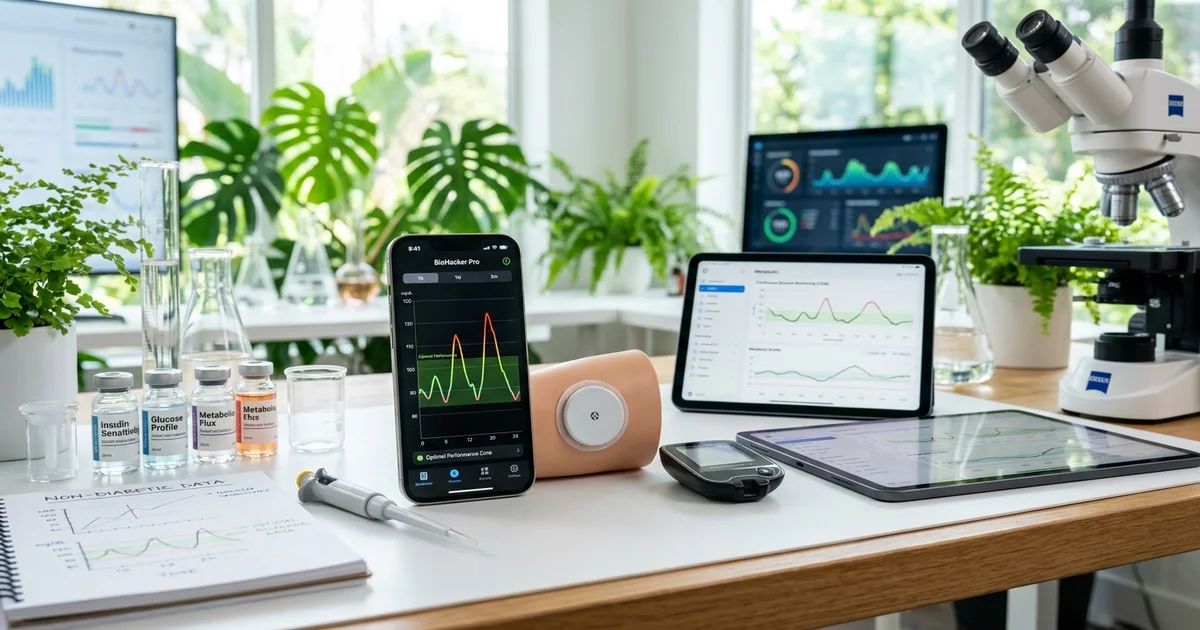
CGM for non-diabetics has shifted from a niche biohacking experiment to a mainstream wellness conversation, driven largely by the rise of consumer-grade continuous glucose monitors and a growing public interest in metabolic health. These small wearable sensors, originally developed to help people with diabetes manage blood sugar without constant finger-prick testing, are now being worn by endurance athletes, longevity enthusiasts, and everyday people who simply want to understand how their bodies respond to food. The question researchers and practitioners are genuinely wrestling with is whether that data translates into meaningful health improvements for people who don't have a clinical glucose disorder.
This article is for informational and research purposes only. Nothing written here constitutes medical advice, and no content should be used to diagnose, treat, or manage any health condition. Always consult a qualified healthcare provider before making changes to your diet, training, or health monitoring protocols.
For researchers looking to source quality compounds, peptide longevity research on PubMed is a supplier worth evaluating.
For a comprehensive overview of the research landscape in this area, see Biohacking Guide: Science-Based Protocols for Human Optimization Research, which maps the key topics and links to the detailed studies covered across this site.
A continuous glucose monitor uses a small filament inserted just beneath the skin to measure interstitial glucose levels, typically every one to fifteen minutes depending on the device. The readings are transmitted wirelessly to a smartphone or receiver, creating a real-time graph of how blood sugar rises and falls throughout the day. For people with Type 1 or Type 2 diabetes, this information is clinically essential. For metabolically healthy individuals, it's a window into physiology that was previously invisible.
The consumer interest exploded partly because of high-profile figures in the longevity and performance space who began publicly discussing their glucose data. Researchers studying metabolic health, sleep optimization, and even strength training protocols noticed that glucose variability, not just fasting glucose, seemed to carry independent significance. Fasting glucose can appear perfectly normal on a standard blood panel while a person's post-meal spikes are substantially elevated. CGMs make that hidden variability visible, which is precisely what attracted the non-diabetic audience.
Companies like Abbott (with the Libre line) and Dexcom began releasing products with streamlined consumer interfaces. Prescription requirements vary by country, but in some markets non-diabetic users can access these sensors through direct telehealth providers. The technology itself is reliable for continuous trending, though it's worth understanding that interstitial glucose lags behind blood glucose by roughly five to fifteen minutes, and accuracy benchmarks differ between populations studied.
Here's where the picture gets genuinely complicated. Research suggests that even metabolically healthy individuals show meaningful variation in postprandial glucose response depending on meal composition, stress levels, sleep quality, and exercise timing. A landmark study conducted by researchers at the Weizmann Institute found that individuals eating identical foods produced dramatically different glucose responses, suggesting that population-level dietary advice may miss individual metabolic reality entirely. That finding fueled a wave of interest in personalized nutrition, and CGMs became the obvious measurement tool.
Glucose variability, often measured as mean amplitude of glycemic excursions (MAGE) or standard deviation of glucose readings, has been associated in observational research with markers of oxidative stress and endothelial function. The key word is "associated." These are correlational signals in largely observational studies, and the causal direction isn't always clear. A person who sleeps poorly, eats late, and is under chronic psychological stress will show worse glucose patterns, but the glucose variability itself may be a symptom of those lifestyle factors rather than an independent driver of harm.
For athletes and those interested in body composition, CGMs provide a layer of information that connects naturally to discussions around insulin sensitivity, training periodization, and carbohydrate timing. Research in exercise physiology has long established that aerobic activity improves insulin sensitivity acutely and chronically, and CGM data can show this effect playing out in real time after a workout. Seeing a blunted glucose spike following a morning run compared to a sedentary morning can be genuinely motivating for behavior change.
One acknowledged limitation in the existing literature is that most CGM studies in non-diabetic populations are short in duration, often spanning just two to four weeks. It's unclear whether the behavioral changes people make in response to their glucose data are sustained long-term, or whether they fade once the novelty of the sensor wears off. This is a meaningful gap, and honest practitioners in this space acknowledge it openly.
According to practitioners working in functional medicine and metabolic health coaching, the most common and actionable insight non-diabetic CGM users report is understanding how specific foods affect their individual glucose response. White rice may produce a steep, rapid spike in one person and a modest, slow rise in another. Sourdough bread, which has a lower glycemic index than standard white bread due to its fermentation process, sometimes behaves differently in practice than glycemic index tables predict for a given individual.
Users also frequently discover the significant impact of meal order on glucose response. Research suggests that consuming fiber and protein before carbohydrates in a meal can meaningfully reduce postprandial glucose excursions. This is a low-cost, practical intervention that doesn't require supplements or specialized foods. A CGM makes the effect quantifiable in a way that general dietary advice rarely achieves.
Sleep is another domain where CGM data tells an interesting story. Poor sleep is well-established in the research literature as a driver of impaired glucose tolerance, and non-diabetic CGM users often observe this connection directly. After a night of disrupted or shortened sleep, many users see elevated fasting glucose and exaggerated postprandial responses the following day. For those interested in sleep optimization and its downstream effects on body composition and recovery, this real-time feedback can reinforce the behavioral priority of protecting sleep quality.
Stress responses are also visible in glucose data. Cortisol stimulates hepatic glucose production through gluconeogenesis, meaning psychological stress, intense exercise, or even cold exposure can raise blood glucose without any food intake. First-time CGM users are often surprised to see their glucose climb during a stressful work call. This isn't pathological in a healthy individual, but it contextualizes why a glucose reading taken in isolation can be misleading without broader lifestyle context.
Proponents argue that metabolic disease doesn't appear overnight. Insulin resistance develops gradually over years, often without overt symptoms, and by the time fasting glucose enters the pre-diabetic range, significant physiological changes have already occurred. Using a CGM earlier, the argument goes, allows people to identify patterns and make adjustments before clinical thresholds are reached. This is a prevention-oriented framing, and it aligns with a broader shift in health culture toward monitoring and early intervention rather than reactive treatment.
The counterargument, raised by endocrinologists and primary care physicians, centers on context and interpretation. A glucose spike after eating is normal physiology. Healthy beta-cell function is specifically designed to handle postprandial glucose rises and bring levels back to baseline efficiently. Without clinical training, non-diabetic users may interpret normal variation as pathological, leading to unnecessary food restriction, anxiety around eating, or overcorrection through excessive low-carbohydrate eating that may not suit their health goals, lifestyle, or training demands.
There's also a cost consideration. Consumer CGM sensors aren't inexpensive, and the data they generate requires either practitioner guidance or a significant investment of personal time to interpret meaningfully. Apps that accompany CGMs vary widely in the quality of their coaching algorithms, and research validating those algorithms specifically in non-diabetic populations is sparse. People interested in tracking metabolic health alongside other biomarkers, such as heart rate variability, strength metrics, or hormonal panels, should consider how CGM data fits into a broader picture rather than treating it as a standalone answer.
One concrete opinion worth stating plainly: the value of a CGM for a non-diabetic individual scales almost entirely with what they do with the data. Wearing a sensor and watching the graph without applying behavioral or nutritional adjustments is unlikely to produce meaningful outcomes. The sensor is a feedback tool, and like any feedback tool, its benefit depends on the quality of the response it generates.
Glucose monitoring doesn't exist in isolation for most practitioners who use it seriously. It connects naturally to conversations about time-restricted eating, where meal timing is structured to align with circadian rhythms and natural insulin sensitivity patterns. Research suggests insulin sensitivity peaks in the morning and declines through the evening, meaning the same meal consumed at breakfast may produce a different glucose response than when eaten at dinner. CGM data can make this abstract concept personal and measurable.
Strength training and muscle mass are also deeply relevant here. Skeletal muscle is the primary site of glucose disposal in the body, accounting for the majority of insulin-stimulated glucose uptake. People with higher muscle mass and metabolic fitness tend to show better glucose control across multiple studies. For those engaged in resistance training protocols, CGM data can reinforce why building and maintaining muscle is a powerful metabolic investment, not merely an aesthetic one.
Discussions around peptide research and metabolic signaling pathways have also touched on glucose regulation, particularly in relation to compounds studied for their effects on insulin signaling and cellular energy metabolism. These connections remain largely in the research phase, and their relevance to consumer CGM use is speculative at this stage, but they reflect the broader scientific interest in understanding how multiple systems interact to regulate metabolic health.
The picture that emerges from the available data is one of genuine utility paired with real interpretive complexity. CGM technology gives non-diabetic users access to a layer of physiological information that was previously inaccessible outside a clinical research setting. Whether that access translates into better health outcomes depends heavily on how the data is used, who helps interpret it, and whether it's integrated into a coherent and sustainable approach to lifestyle and metabolic health rather than treated as a shortcut to answers the technology alone can't provide.
For research purposes only — not medical advice.