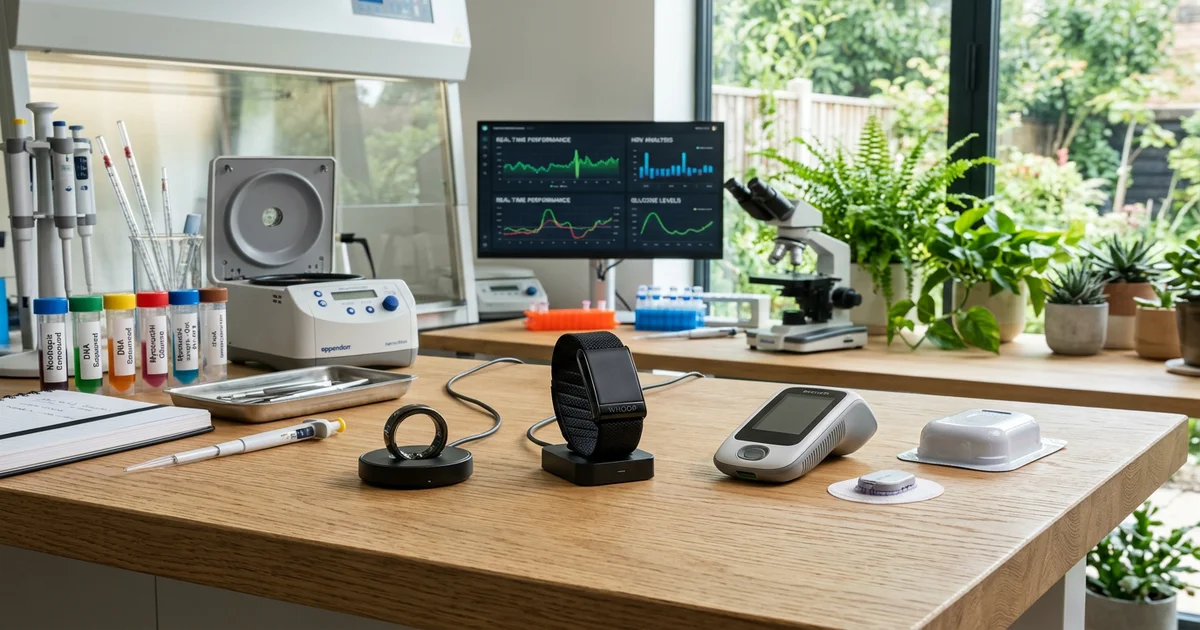
A wearable biohacking tech comparison has become one of the most searched topics among health-optimization enthusiasts, athletes, and longevity-focused individuals who want to move beyond guesswork and into data-driven self-management. The landscape of consumer-grade biosensors has shifted dramatically over the past several years, producing devices that once existed only in clinical or research settings. Today, three platforms dominate the conversation: the Oura Ring, the WHOOP Strap, and continuous glucose monitors (CGMs) used in a non-diabetic performance context. Each captures a distinct slice of physiology, and understanding what each measures, how it measures it, and where it falls short is essential before committing to any single device or combination.
The Oura Ring is a photoplethysmography (PPG)-based sensor embedded in a titanium ring worn on the finger. Because the finger carries a high density of capillaries close to the skin surface, Oura's optical sensors can capture heart rate, heart rate variability (HRV), blood oxygen saturation (SpO2), skin temperature, and respiratory rate with relatively strong signal quality compared to wrist-based devices. The ring aggregates these signals overnight and produces three composite scores: Readiness, Sleep, and Activity. The readiness score, in particular, draws on HRV trends, resting heart rate, body temperature deviations, and recent training load to offer a single number that practitioners often use as a proxy for recovery status.
WHOOP takes a different philosophical approach. Rather than producing sleep stages or a daily activity summary, WHOOP centers its entire experience on the recovery-to-strain cycle. Its proprietary "Strain" score is a 0 to 21 cardiovascular load metric derived from heart rate data accumulated throughout the day. The recovery score, expressed as a percentage, leans heavily on HRV, resting heart rate, and sleep performance. WHOOP is worn on the wrist or, with an optional bicep band, higher up the arm, and it operates without a screen to minimize distraction and battery drain. According to practitioners who work with collegiate and professional athletes, WHOOP's strain-to-recovery ratio is particularly useful for periodizing training intensity over multi-week cycles.
For a comprehensive overview of the research landscape in this area, see Biohacking Guide: Science-Based Protocols for Human Optimization Research, which maps the key topics and links to the detailed studies covered across this site.
Continuous glucose monitors occupy a fundamentally different category. Devices like the Abbott Libre Sense or Dexcom's performance-oriented options use a small subcutaneous filament to measure interstitial glucose in real time, typically updating every one to five minutes. In clinical medicine, CGMs are indispensable for managing type 1 and type 2 diabetes. In the biohacking and performance community, they are being used by metabolically healthy individuals to observe how meals, exercise, stress, and sleep affect blood sugar stability. Research suggests that even in non-diabetic populations, meaningful variability in postprandial glucose responses exists between individuals eating identical foods, a phenomenon sometimes called personalized glycemic response. This variability is why some practitioners consider CGM data uniquely actionable for nutrition strategies.
Sleep is arguably the highest-leverage variable in any health optimization protocol, intersecting with hormone regulation, neurological recovery, immune function, and metabolic health. Both Oura and WHOOP attempt to classify sleep into stages: light, deep (slow-wave), REM, and awake. These classifications rely on actigraphy combined with heart rate and HRV signals, a methodology that has known limitations when compared to polysomnography (PSG), which remains the clinical gold standard.
Independent validation studies have found that consumer wrist and ring devices tend to overestimate total sleep time and show variable accuracy in detecting specific sleep stages, particularly slow-wave sleep. Oura has historically performed better than many wrist-based competitors in peer-reviewed comparisons, likely because finger-based PPG captures cleaner cardiac signal. WHOOP has also invested in ongoing validation research and updated its algorithms across hardware generations. The honest framing for both devices is that they are most useful for detecting trends over time rather than providing precise nightly stage data. A week-over-week decline in deep sleep percentage, for instance, is more meaningful than any single night's reading.
CGMs contribute an indirect but complementary lens on sleep quality. Research suggests that nighttime glucose stability correlates with sleep architecture quality, with nocturnal glucose spikes sometimes associated with fragmented sleep or early waking. Practitioners who use CGMs in performance contexts often note that late-evening carbohydrate intake or alcohol consumption can produce observable glucose perturbations during sleep hours, providing an explanation for why recovery scores from Oura or WHOOP appear suppressed the following morning.
Heart rate variability has become a central metric in wearable biohacking because it offers a non-invasive window into autonomic nervous system balance, specifically the interplay between sympathetic and parasympathetic tone. A higher HRV, particularly when viewed against an individual's personal baseline, generally suggests the body is in a parasympathetically dominant, recovery-favorable state. A suppressed HRV reading often indicates accumulated stress load, whether from intense exercise, poor sleep, illness onset, or psychosocial stressors.
Both Oura and WHOOP calculate HRV using the rMSSD method, which measures the root mean square of successive RR interval differences. Oura captures its primary HRV reading during the deepest phase of sleep, typically in the first half of the night, which many researchers consider a more stable and meaningful measurement window than an awake morning reading. WHOOP averages HRV across sleep in a slightly different windowing approach. The numeric outputs from these two devices are not directly comparable to each other due to algorithmic differences, which is an important caveat for anyone switching devices mid-experiment or attempting to cross-reference published HRV norms.
Understanding HRV in the context of peptide research, adaptogens, and other recovery-oriented interventions is an area of growing interest. HRV has been proposed as a measurable endpoint for observing how various recovery strategies affect autonomic balance over time, making these devices useful tracking tools in self-experimentation contexts. Similarly, those studying the relationship between sleep peptides and sleep architecture may find that nightly HRV trend data provides a meaningful longitudinal signal to complement subjective reports.
Among the three device categories, CGMs carry the most direct and immediate feedback loop for nutrition behavior. When a user eats a meal and observes a sharp glucose spike followed by a rapid crash, the physiological and behavioral consequences become concrete and visible rather than theoretical. Research suggests that individuals who receive real-time CGM feedback frequently self-modify their eating behaviors, including adjusting meal composition, eating order, or post-meal movement habits, at higher rates than individuals relying on general dietary guidance alone.
Several patterns are commonly reported by practitioners using CGMs in healthy populations. First, the glycemic response to identical foods varies considerably between individuals, meaning population-average glycemic index tables are imprecise guides for any specific person. Second, the timing and intensity of exercise relative to meals appears to influence postprandial glucose curves, with post-meal walks consistently showing glucose-attenuating effects in multiple studies. Third, sleep deprivation as tracked by Oura or WHOOP frequently corresponds with worsened glucose regulation the following day, a relationship that connects several of the device categories into a unified picture of metabolic health.
CGMs are not without limitations in non-clinical applications. Interstitial glucose lags behind blood glucose by approximately 5 to 15 minutes, which can distort readings during rapid changes such as those following high-intensity exercise. Sensor compression artifacts, sweat, and altitude can affect accuracy. Most CGMs approved for diabetic management have not been independently validated for precision in the sub-pathological glucose ranges that metabolically healthy individuals typically occupy. Practitioners in this space recommend treating CGM data as directional signal rather than clinical-grade measurement.
The most common mistake in wearable device selection is purchasing based on brand recognition rather than aligning the device's primary output with the user's primary question. Someone whose central concern is optimizing sleep quality and managing training recovery will likely find Oura's ring form factor, sleep staging detail, and temperature-based illness detection most useful. An endurance athlete or team-sport competitor who needs to manage daily cardiovascular strain against a recovery ceiling may find WHOOP's strain-to-recovery framework more operationally relevant.
An individual primarily focused on understanding their metabolic response to food, managing energy stability across the day, or exploring the relationship between carbohydrate timing and body composition may find a two to four week CGM trial the highest-value investment, even if they ultimately discontinue regular use after establishing a personalized glucose response baseline. The CGM-plus-sleep-tracker stack has become a popular combination because it allows users to observe the bidirectional relationship between sleep quality and metabolic regulation, connecting areas like fasting protocols, exercise timing, and stress management into a coherent feedback system.
Cost structures differ considerably. Oura and WHOOP both require subscription fees in addition to hardware costs. CGMs in non-prescription contexts vary in accessibility depending on geography and distribution channel. Stacking all three simultaneously produces a significant data volume that, without a structured analysis framework, can become noise rather than signal. Practitioners often recommend starting with a single device and spending at least 30 days establishing baseline patterns before adding a second data layer.
Raw scores from any wearable device are only as useful as the interpretive framework applied to them. A readiness score of 67 from Oura or a recovery score of 42 percent from WHOOP means little in isolation. The signal becomes actionable when viewed against an individual's personal 30 to 90 day baseline, tracked against a training log, correlated with subjective energy and mood ratings, and considered alongside other variables such as alcohol intake, travel across time zones, or periods of elevated life stress.
Practitioners working in sports science and biohacking coaching frequently emphasize that wearables should function as confirmation and refinement tools rather than primary decision-makers. Subjective feel remains an important input, and periods where device scores and subjective experience diverge are often the most instructive data points. Research into areas like gut health, circadian biology, and stress physiology continues to provide explanatory frameworks for these divergences, expanding the interpretive vocabulary available to informed users.
The field is moving toward integration, with platforms beginning to aggregate data across devices and apply machine learning to surface personalized patterns that individual device ecosystems cannot identify in isolation. As this integration matures, the wearable biohacking category will likely shift from isolated data collection toward a more systems-oriented picture of individual physiology.
This article is for informational and research purposes only and does not constitute medical advice, diagnosis, or treatment guidance. The devices and technologies described are discussed in an educational context. Individuals with health conditions or specific medical concerns should consult a qualified healthcare provider before making changes to their health monitoring, nutrition, or training practices. For research purposes only, not medical advice.